Weizmann Segmentation Evaluation Database



Overview
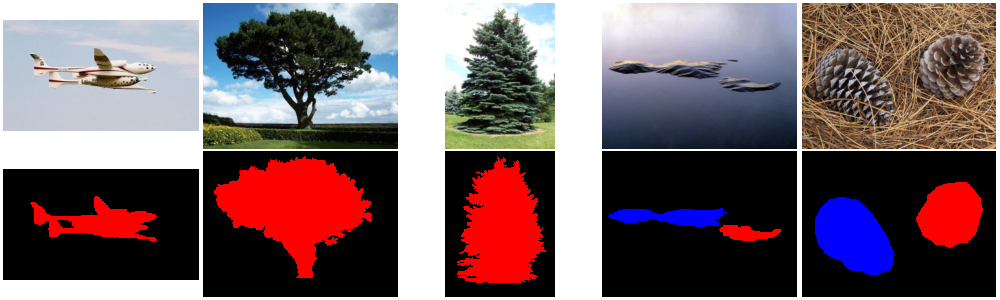
The Weizmann Segmentation Evaluation Database is a benchmark for figure-ground segmentation: separating one or two salient objects from the background. It contains 200 natural images, most with a longer side of 300 pixels, each provided in color and in grayscale. Each image comes with up to three human segmentations. It is meant for evaluation only: there is no training split and there are no class labels.
one_object: 100 images showing one object, each with 3 human segmentations
two_objects: 100 images showing two objects, each with 1 to 3 human segmentations (87 with 3, 8 with 2, 5 with 1)
In the original files, annotators painted the object red (and, in two_objects, the second object blue) on top of the image. stable-datasets converts each of these into a label map: 0 = background, 1 = red object, 2 = blue object.
Note
In two_objects, labels 1 and 2 are not matched across annotators: the same object can be red in one annotation and blue in another. Of the 182 annotations that follow an image’s first annotation, 68 have the two objects swapped relative to it. Before combining annotators (for example by majority vote), match the objects first, e.g. by swapping labels 1 and 2 in an annotation when that makes it overlap better with the first one.
Data Structure
When accessing an example using ds[i], you will receive a dictionary with the following keys:
Key |
Type |
Description |
|---|---|---|
|
|
Color (RGB) image |
|
|
Grayscale (L) version of the same image; the original benchmark was designed for grayscale |
|
str |
Original image name (e.g. |
|
list[bytes] |
One PNG-encoded label map per annotator; decode with |
decode_mask returns a 2-D uint8 NumPy array with the same height and width as the image.
Usage Example
Basic Usage
from stable_datasets.images import WeizmannSegmentation
from stable_datasets.images.weizmann_seg import decode_mask

# First run will download + prepare cache, then return the split
ds = WeizmannSegmentation(split="one_object")  # or "two_objects"

# If you omit the split (split=None), you get a dict with both splits
ds_all = WeizmannSegmentation(split=None)

sample = ds[0]
print(sample.keys())  # {"image", "image_bw", "image_id", "segmentations"}

# Decode the human segmentations: 0 = background, 1 = first object, 2 = second object
masks = [decode_mask(b) for b in sample["segmentations"]]
print(len(masks), masks[0].shape)  # e.g. 3 (225, 300)
Evaluation
Since the dataset has no training split, methods are typically trained elsewhere (e.g. on BSDS500) and applied as-is. The standard score is the F-measure between a predicted segment and the human segmentations; see Alpert et al. (2007) and the official evaluation code on the dataset website.
References
Official website: https://www.wisdom.weizmann.ac.il/~vision/Seg_Evaluation_DB/
Download page: https://www.wisdom.weizmann.ac.il/~vision/Seg_Evaluation_DB/dl.html
License: research use only (custom terms, no standard license)
The dataset website does not publish a standard license. Its disclaimer makes the database available for research purposes only. The images were taken from royalty-free image collections without permission from the original copyright holders, and users agree to follow the terms of use of each image’s source site. Users also agree to cite Alpert et al. (2007), below.
Citation
@inproceedings{alpert2007image,
  title={Image Segmentation by Probabilistic Bottom-Up Aggregation and Cue Integration},
  author={Alpert, Sharon and Galun, Meirav and Basri, Ronen and Brandt, Achi},
  booktitle={Proceedings of the IEEE Conference on Computer Vision and Pattern Recognition},
  year={2007}
}