ETH-80
Overview
ETH80 loads the original cropped256 release: 3,280 RGB images,
eight object categories, ten physical objects per category, and 41 views per
object. Images have shape 256 x 256. Segmentation maps are excluded.
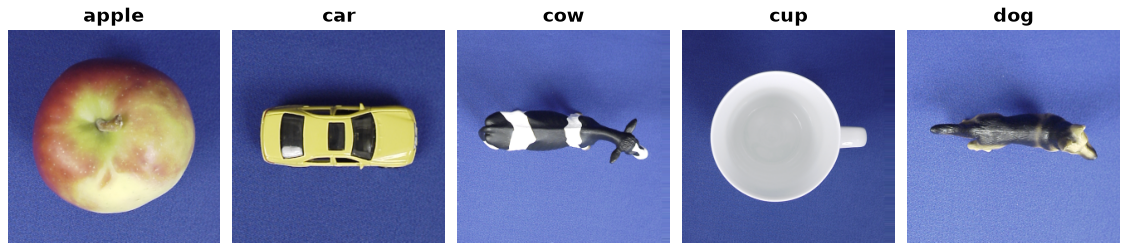
Fig. 1 Five training examples from the ETH-80 cropped256 release by Leibe and Schiele (2003), hosted by the Max Planck Institute for Informatics. The preview uses the original image colors and labels. See Source and terms for the provider link and reuse information.
The archive is downloaded from the Max Planck Institute’s dataset server and checked against a SHA-256 digest measured from that release. Its source page describes cropped256 as the standard set with a 20% border and a consistent scale across views of each object.
Instance-disjoint partitions
These are custom partitions defined by this loader, not official partitions from the original paper. Within each category, the original numeric instance IDs are sorted: the first six objects form the training set, the next two the validation set, and the last two the test set. Every view of an object stays in the same partition.
Split |
Objects |
Images |
Images per class |
|---|---|---|---|
|
48 |
1,968 |
246 |
|
16 |
656 |
82 |
|
16 |
656 |
82 |
Most categories have IDs 1 through 10. Cars have IDs 1, 2, 3, 5, 6, 7, 9, 11, 12, 14. Their training IDs are 1, 2, 3, 5, 6, 7; validation IDs are 9, 11; test IDs are 12, 14. Original IDs are preserved. Do not apply a random image-level split when evaluating unseen objects.
Fields and labels
image: decoded RGB PIL image; a float32 CHW tensor inwith_format("torch").label: integer in the fixed orderapple, car, cow, cup, dog, horse, pear, tomato.object_id: globally unique string, for examplecar14.instance_id: original numeric ID within the category, for example14.view_id: original two-component viewpoint token, for example090-045.image_id: original filename, for examplecar14-090-045.png.
Usage
from torch.utils.data import DataLoader
from stable_datasets.images import ETH80

data = ETH80(
    download_dir="./data/downloads",
    processed_cache_dir="./data/processed",
)
batch = next(iter(DataLoader(data["train"].with_format("torch"), batch_size=8)))
assert batch["image"].shape == (8, 3, 256, 256)
The standard builder handles download locking, Arrow cache writing and reopening.
The archive parser validates all 80 objects and 41 images per object, rejects
malformed or duplicate image names, and reads members without extracting paths
onto the filesystem. Access-time preprocessing can use with_transform.
Source and terms
Release SHA-256:
3552a8199bbf011bcc795364496430dbf936816f89b96ddb7a28af67cc6e6c95.
No explicit dataset license was found on the provider page or in the downloaded archive during verification. The library’s software license does not grant rights to the source images. Reuse terms are determined by the original provider. The repository includes loader code, synthetic test fixtures, and the five attributed preview images above. The full source image archive is not included; the preview images remain subject to the original provider’s terms.
Citation
@inproceedings{leibe2003analyzing,
  title={Analyzing Appearance and Contour Based Methods for Object Categorization},
  author={Leibe, Bastian and Schiele, Bernt},
  booktitle={IEEE Conference on Computer Vision and Pattern Recognition},
  year={2003}
}