DeFungi
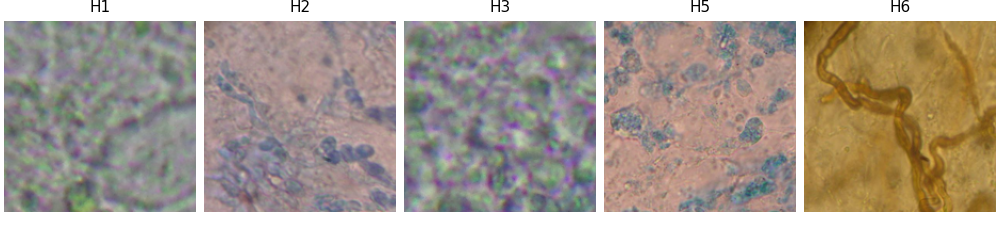
DeFungi contains 9,114 RGB microscopy patches in five classes. This builder preserves the original JPEG bytes and class codes. It provides a custom, deterministic split designed to keep related patches and exact byte duplicates in the same partition.
Source
Download: https://archive.ics.uci.edu/static/public/773/defungi.zip
License: CC BY 4.0, as stated by UCI; distinct from the code license.
ZIP SHA-256:
02020311d1f8207f3aa3bf8b2303a5106463ac0bf35adde4ae042e8b2716ff6c.
The paper describes cropping and filtering microscopy images into patches. The UCI release contains only patches, without patient identifiers or an official split. This integration is for image-classification research.
Classes and splits
Filename-derived source groups use the class and numeric source identifier; all letter variants and patch indices sharing that identifier stay together. The archive has 447 such groups. Exact SHA-256 duplicate links join groups transitively into 440 split groups. The archive contains 59 duplicate pairs, of which 51 cross the initial source groups. All released images are retained, with duplicates confined to a single split.
Within each class, components are ranked by SHA-256 of
defungi-v1:42:<component>. The first floor(70%) are training groups, the next
floor(15%) validation groups, and the remainder test groups, with at least one
group per partition. Image proportions differ because group sizes vary.
The resulting train/validation/test group counts are 306/64/70. This split is
independent of archive ordering, NumPy random-state versions and training seeds.
These are conservative filename-derived groups, not verified patient or slide identities. Similar images with different provenance may still remain across partitions. This custom protocol is not directly comparable to the paper’s reported scores. Class imbalance makes balanced accuracy and macro-F1 useful alongside ordinary accuracy. The supplied labels are preserved without reinterpreting them as species-level diagnoses.
Returned fields
image: decoded RGB PIL image, width 500 and height 500.label: integer class id in the table above.image_id: original archive member name.source_group: class plus numeric source id, for exampleH1_100.split_group: canonical representative of a duplicate-linked component.
Usage
Install this contribution’s checkout with python -m pip install -e ..
An older released package does not include this builder. A Windows script
uses a main guard because the shared downloader starts subprocesses:
from stable_datasets.images import DeFungi

def main():
    data = DeFungi()
    print({name: len(split) for name, split in data.items()})
    sample = data["train"][0]
    print(sample["image"].size, sample["label"], sample["source_group"])

if __name__ == "__main__":
    main()
DeFungi(split="train") returns a single split. download_dir and
processed_cache_dir control cache locations. The shared ZIP is downloaded
once and verified on a fresh download; subsequent loads reuse the Arrow cache.
Tests
The integration test downloads the public archive through DeFungi into
fresh temporary directories. It checks exact split and class counts, fields
and label ranges, all 9,114 image decodes, unique image IDs, source-group and
linked-group separation, and that identical JPEG bytes never cross splits.
It also checks loading from the processed cache. No manual download or login
is required.
python -m pytest stable_datasets/tests/images/test_defungi.py -q
Citation
@misc{sopo2021defungi,
  title = {DeFungi: Direct Mycological Examination of Microscopic Fungi Images},
  author = {Pineda Sopo, Camilo Javier and Hajati, Farshid and Gheisari, Soheila},
  year = {2021},
  eprint = {2109.07322},
  archivePrefix = {arXiv},
  doi = {10.48550/arXiv.2109.07322}
}