Stanford40



Overview
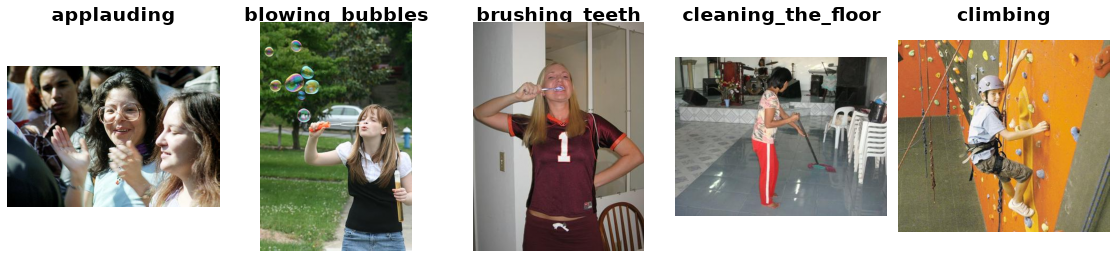
Stanford40 contains 9,532 still images of people performing 40 actions, such as reading, riding a bike, and playing a guitar. It is a single-label image classification dataset with 180 to 300 images per action class.
This loader uses the official train/test split files:
Train: 4,000 images (100 per class)
Test: 5,532 images
Images are returned as RGB at their original resolution. The source archive
contains one grayscale JPEG (feeding_a_horse_191.jpg); the loader
converts it, and any other non-RGB image, to RGB so every example has three
channels. The loader uses the full images; it does not load the
bounding-box annotations or crop to the person.
Labels are zero-based indices into alphabetically sorted action names.
No separate validation split is provided.
Data Structure
When accessing an example using ds[i], you receive a dictionary with
the following keys:
Key |
Type |
Description |
|---|---|---|
|
|
Full RGB action image at its original resolution. |
|
|
Action class index (0-39). |
Usage Example
Basic Usage
Save this example as a Python file and run it. The main guard supports platforms that use multiprocessing with the spawn start method.
from stable_datasets.images.stanford40 import Stanford40

def main():
    # First load downloads the data and prepares the processed cache.
    # Later loads reuse the cache and return a StableDataset.
    train = Stanford40(split="train")
    test = Stanford40(split="test")

    sample = train[0]
    print(sample.keys())  # image, label
    print(sample["image"].size)
    print(sample["label"])
    print(len(train), len(test))  # 4000 5532

    # Look up the action name for a label.
    class_names = train.features["label"].names
    print(class_names[sample["label"]])

    # Load all available splits as a StableDatasetDict.
    all_splits = Stanford40(split=None)
    print(all_splits.keys())  # train, test

    # Optionally request PyTorch-formatted samples.
    train_torch = train.with_format("torch")
    print(train_torch[0]["image"].shape)

if __name__ == "__main__":
    main()
Images have variable sizes. Apply suitable resizing or cropping before stacking them into training batches.
References
Archived copies of the official files (used as checksummed fallbacks): images, splits
License: Unknown
The official dataset page does not publish a license or terms of use. The images were collected from the web, so copyright remains with the original owners. Check with the data provider for applicable use terms, and cite the paper below when using the dataset.
Citation
@inproceedings{yao2011human,
  title = {Human Action Recognition by Learning Bases of Action Attributes and Parts},
  author = {Yao, Bangpeng and Jiang, Xiaoye and Khosla, Aditya and
            Lin, Andy Lai and Guibas, Leonidas and Fei-Fei, Li},
  booktitle = {2011 International Conference on Computer Vision},
  year = {2011}
}