DeepWeeds



Overview
DeepWeeds contains 17,509 field images (256×256 RGB) of eight weed species native to Australia, photographed in situ among neighboring vegetation, plus a negative class of images without any of the target weeds. The images were collected at eight sites across Queensland: Black River, Charters Towers, Cluden, Douglas, Hervey Range, Kelso, McKinlay and Paluma.
The authors publish five official train/validation/test splits (about 60/20/20). Each is available as a builder variant, subset0 to subset4; subset0 is the default.
Train (
subset0): 10,501 imagesValidation (
subset0): 3,501 imagesTest (
subset0): 3,507 images
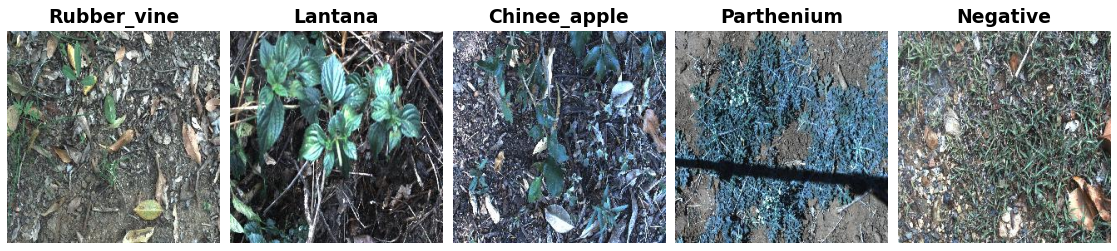
Data Structure
When accessing an example using ds[i], you will receive a dictionary with the following keys:
Key |
Type |
Description |
|---|---|---|
|
|
256×256 RGB field image |
|
int |
Class label (0-8) |
Classes
Label |
Class Name |
Images (all 17,509) |
|---|---|---|
0 |
Chinee_apple |
1,125 |
1 |
Lantana |
1,064 |
2 |
Parkinsonia |
1,031 |
3 |
Parthenium |
1,022 |
4 |
Prickly_acacia |
1,062 |
5 |
Rubber_vine |
1,009 |
6 |
Siam_weed |
1,074 |
7 |
Snake_weed |
1,016 |
8 |
Negative |
9,106 |
The negative class makes up 52% of the images, so accuracy alone is a weak metric: always predicting Negative already scores about 52%. Report per-class or class-balanced metrics alongside it.
Usage Example
Basic Usage
from stable_datasets.images import DeepWeeds

# Default variant (subset0)
train_ds = DeepWeeds(split="train")
val_ds = DeepWeeds(split="validation")
test_ds = DeepWeeds(split="test")

sample = train_ds[0]
print(sample.keys())  # {"image", "label"}
print(sample["image"].size)  # (256, 256)

# Optional: make it PyTorch-friendly
train_torch = train_ds.with_format("torch")
Choosing an Official Split
from stable_datasets.images import DeepWeeds

# Variants subset0 ... subset4; results in the paper are averaged over all five
ds = DeepWeeds(config_name="subset2", split="train")
Getting Class Names
from stable_datasets.images import DeepWeeds

ds = DeepWeeds(split="train")
class_names = ds.info.features["label"].names
print(class_names[ds[0]["label"]])
Notes
Image hosting: the images archive is downloaded from the authors’ Google Drive link.
Label and split files:
labels.csvand the 15 split files are downloaded as one archive of the authors’ GitHub repository, pinned to commitda084f6.One label conflict in the source data: image
20170714-110407-3.jpgis labeled 1 (Lantana) inlabels.csvbut 0 (Chinee apple) in all five split files. The builder takes labels fromlabels.csvonly and uses the split files for split membership, as TensorFlow Datasets does.
References
Homepage: https://github.com/AlexOlsen/DeepWeeds
License: CC BY 4.0 (images and annotations)
Published baseline: 95.7% average accuracy with an ImageNet-pretrained ResNet50, averaged over the five official splits
Citation
@article{DeepWeeds2019,
  author = {Alex Olsen and Dmitry A. Konovalov and Bronson Philippa and Peter Ridd and Jake C. Wood
            and Jamie Johns and Wesley Banks and Benjamin Girgenti and Owen Kenny and James Whinney
            and Brendan Calvert and Mostafa {Rahimi Azghadi} and Ronald D. White},
  title = {{DeepWeeds: A Multiclass Weed Species Image Dataset for Deep Learning}},
  journal = {Scientific Reports},
  year = {2019},
  volume = {9},
  number = {2058},
  doi = {10.1038/s41598-018-38343-3},
  url = {https://doi.org/10.1038/s41598-018-38343-3}
}