Cars3D


Overview
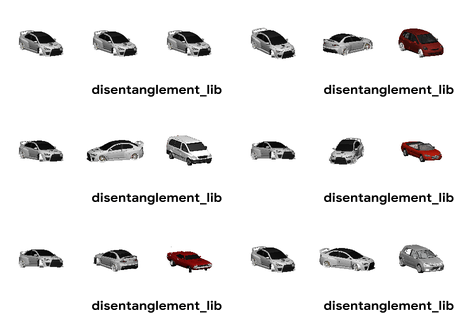
The Cars3D dataset is a synthetic benchmark widely used for disentangled and unsupervised representation learning. It consists of rendered images of 3D car models under controlled variations of viewpoint factors, with all generative factors fully known.
Each image depicts a single car model rendered from a specific azimuth and elevation angle. The dataset forms a complete Cartesian product of car identity and viewpoint factors, making it suitable for studying factor disentanglement, invariance, and controllable representation learning.
Total images:
Image resolution: 128×128×3 (RGB)
Latent Factors of Variation
The dataset is generated from three independent latent factors:
Factor |
Discrete Values |
|---|---|
|
{0, …, 182} (183 distinct car models) |
|
{0, …, 23} (viewpoint rotation around the vertical axis) |
|
{0, …, 3} (camera elevation angle) |
Each image corresponds to a unique combination of these factors.
Data Structure
When accessing an example using ds[i], you will receive a dictionary with the following keys:
Key |
Type |
Description |
|---|---|---|
|
|
128×128 RGB image |
|
|
Index of the car model (0–182) |
|
|
Elevation index (0–3) |
|
|
Azimuth index (0–23) |
|
|
Discrete latent indices: |
Usage Example
Basic Usage
from stable_datasets.images.cars3d import Cars3D

ds = Cars3D(split="train")

sample = ds[0]
print(sample.keys())

image = sample["image"]
label = sample["label"]

car_type, elevation, azimuth = label

ds_torch = ds.with_format("torch")
Why No Train/Test Split?
Cars3D does not provide an official train/test split. It is designed for representation learning and disentanglement research, where evaluation typically focuses on:
Factor-wise predictability
Disentanglement metrics
Controlled generalization across latent variables
Since the dataset enumerates all combinations of car identity and viewpoints, common protocols rely on post-hoc evaluation rather than predefined semantic splits.
References
Dataset source: http://www.scottreed.info/
Original release: Reed et al., NIPS 2015 (analogy dataset)
Common usage: Locatello et al., Challenging Common Assumptions in the Unsupervised Learning of Disentangled Representations, ICML 2019
License: Apache License 2.0
Citation
@inproceedings{locatello2019challenging,
  title={Challenging Common Assumptions in the Unsupervised Learning of Disentangled Representations},
  author={Locatello, Francesco and Bauer, Stefan and Lucic, Mario and
          Raetsch, Gunnar and Gelly, Sylvain and Sch{\"o}lkopf, Bernhard and Bachem, Olivier},
  booktitle={International Conference on Machine Learning},
  pages={4114--4124},
  year={2019}
}