CLEVRER




Overview
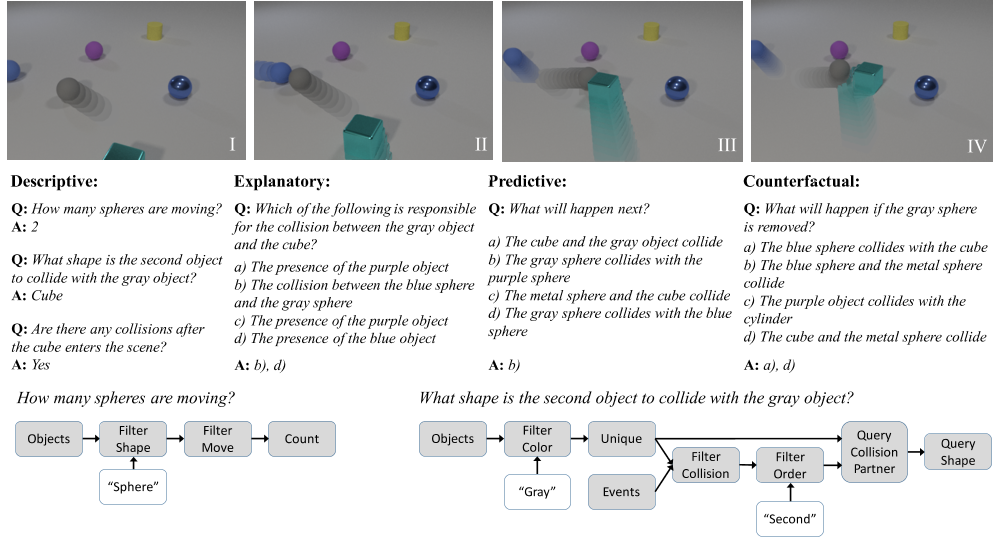
CLEVRER (CoLlision Events for Video REpresentation and Reasoning) is a diagnostic video dataset designed for systematic evaluation of computational models on temporal and causal reasoning tasks.
The dataset contains 20,000 synthetic videos of moving and colliding objects (spheres, cubes, cylinders) with various colors and materials. Each video is 5 seconds long with 128 frames at resolution 480×320.
CLEVRER includes four types of questions:
Descriptive: e.g., “What color is the sphere?”
Explanatory: e.g., “What’s responsible for the collision?”
Predictive: e.g., “What will happen next?”
Counterfactual: e.g., “What if the red cube were removed?”
Split sizes:
Train: 10,000 videos (index 0-9999)
Validation: 5,000 videos (index 10000-14999)
Test: 5,000 videos (index 15000-19999)
Data Structure
When accessing an example using ds[i], you will receive a dictionary with the following keys:
Key |
Type |
Description |
|---|---|---|
|
|
MP4 video file (480×320, 128 frames) |
|
int |
Unique scene identifier |
|
str |
Original video filename (e.g., “video_00001.mp4”) |
|
str |
JSON string containing list of questions with answers |
|
str |
JSON string containing object properties and collision events |
Questions JSON Structure
Each question in questions_json contains:
{
    "question_id": 0,
    "question": "What color is the sphere?",
    "question_type": "descriptive",  # or explanatory, predictive, counterfactual
    "answer": "blue",
    "choices": [...]  # for multiple choice questions
}
Annotations JSON Structure
The annotations_json contains:
{
    "object_property": [
        {"object_id": 0, "color": "blue", "material": "rubber", "shape": "sphere"},
        ...
    ],
    "collision": [
        {"frame_id": 19, "object_ids": [0, 1]},
        ...
    ],
    "motion_trajectory": [...]
}
Usage Example
Basic Usage
import json
from stable_datasets.images.clevrer import CLEVRER

# Load the train split
ds = CLEVRER(split="train")

sample = ds[0]
print(sample.keys())  # {"video", "scene_index", "video_filename", "questions_json", "annotations_json"}

# Parse questions
questions = json.loads(sample["questions_json"])
print(f"First question: {questions[0]['question']}")
print(f"Answer: {questions[0]['answer']}")

# Parse annotations
annotations = json.loads(sample["annotations_json"])
print(f"Objects in scene: {len(annotations.get('object_property', []))}")
Working with Videos
# sample["video"] is a lazy VideoRef; decode it yourself or use
# dataset-level video decode configuration.
video = sample["video"]
from torchcodec.decoders import VideoDecoder

decoder = VideoDecoder(str(video.path))
frame = decoder.get_frame_at(0.0)
print(f"Frame shape: {frame.data.shape}")
Requirements
Video decoding requires torchcodec:
pip install torchcodec
Note
Large Download Size: The CLEVRER video files are very large (~12GB for train, ~6GB each for validation/test).
This dataset uses wget with resume support (-c flag) instead of the standard download method to handle
these large files reliably. If a download is interrupted, it will automatically resume from where it left off.
References
Official website: http://clevrer.csail.mit.edu/
Paper: CLEVRER: CoLlision Events for Video REpresentation and Reasoning (ICLR 2020)
License: CC0
Citation
@inproceedings{yi2020clevrer,
    title={CLEVRER: CoLlision Events for Video REpresentation and Reasoning},
    author={Yi, Kexin and Gan, Chuang and Li, Yunzhu and Kohli, Pushmeet and Wu, Jiajun and Torralba, Antonio and Tenenbaum, Joshua B},
    booktitle={International Conference on Learning Representations},
    year={2020}
}