Scream dSprites


Overview
The Scream dSprites dataset is a synthetic benchmark designed for disentangled and unsupervised representation learning. It is a variant of the original dSprites dataset, where each object sprite is embedded onto a random patch from a Scream painting image used as background.
In this Scream variant, the object is rendered by inverting the pixel colors of the sprite region on top of the background patch. This introduces a structured and highly textured background, enabling evaluation of robustness to complex background variation and testing how well models can disentangle latent factors under realistic nuisance conditions.
The dataset contains all possible combinations of six latent factors of variation inherited from dSprites, with each combination appearing exactly once.
Total images: 737,280
Image resolution: 64×64×3 (textured background with inverted object)
Latent Factors of Variation
The dataset is generated from six independent latent factors, consistent with the original dSprites specification. In this variant, no additional latent factor is introduced; the background texture is applied independently of the ground-truth factors.
Factor |
Discrete Values |
Description |
|---|---|---|
|
{0} |
Fixed label; object pixels inverted on Scream background |
|
{0, 1, 2} |
Square, ellipse, heart |
|
{0, …, 5} |
Linearly spaced in [0.5, 1.0] |
|
{0, …, 39} |
Uniform in [0, 2π] radians |
|
{0, …, 31} |
Normalized position in [0, 1] |
|
{0, …, 31} |
Normalized position in [0, 1] |
Each image corresponds to a unique combination of these six latent factors. The factor indexing and ordering are identical to the original dSprites dataset.
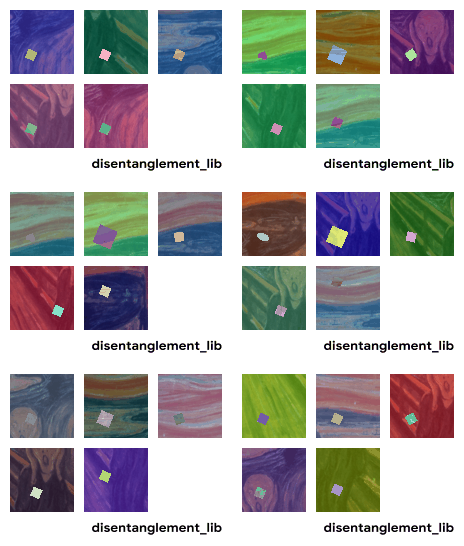
Scream Background Visualization
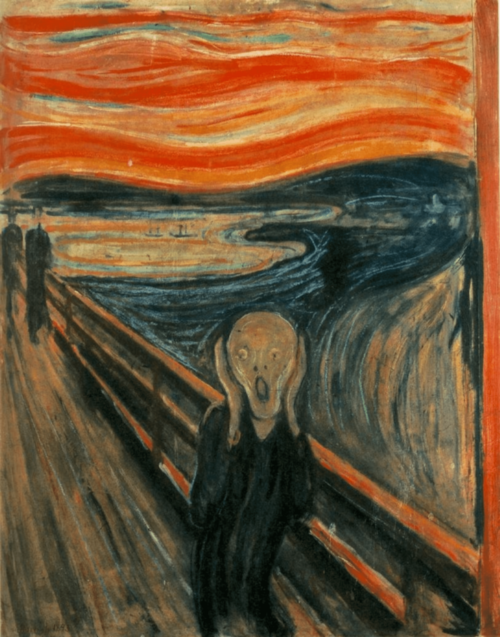
The background patches are sampled from a fixed Scream painting image.
Data Structure
When accessing an example using ds[i], you will receive a dictionary with the following keys:
Key |
Type |
Description |
|---|---|---|
|
|
64×64×3 image with Scream background |
|
|
Discrete latent indices: |
|
|
Continuous latent values corresponding to |
|
|
Individual discrete latent factors |
|
|
Individual continuous latent values |
Note:
The color and colorValue fields remain fixed to preserve compatibility with the original dSprites format.
The object is rendered by pixel inversion on top of the Scream background.
Usage Example
Basic Usage
from stable_datasets.images.dsprites_scream import DSpritesScream

# First run will download + prepare cache, then return the split as a HF Dataset
ds = DSpritesScream(split="train")

# If you omit the split (split=None), you get a DatasetDict with all available splits
ds_all = DSpritesScream(split=None)

sample = ds[0]
print(sample.keys())

image = sample["image"]
factors = sample["label"]
factor_values = sample["label_values"]

# Optional: make it PyTorch-friendly
ds_torch = ds.with_format("torch")
Why No Train/Test Split?
The Scream dSprites dataset does not define an official train/test split. It is intended for representation learning research, where models are trained to capture underlying factors of variation rather than to generalize across semantic classes.
Because the dataset is a complete Cartesian product of all factor combinations, common evaluation protocols rely on:
Factor-wise generalization
Metric-based disentanglement scores
Robustness to structured background textures
Controlled interventions on latent variables
References
Dataset repository: https://github.com/google-research/disentanglement_lib/
License: Apache License 2.0
Paper: Locatello et al., Challenging Common Assumptions in the Unsupervised Learning of Disentangled Representations, ICML 2019
Citation
@inproceedings{locatello2019challenging,
  title={Challenging Common Assumptions in the Unsupervised Learning of Disentangled Representations},
  author={Locatello, Francesco and Bauer, Stefan and Lucic, Mario and
          Raetsch, Gunnar and Gelly, Sylvain and
          Sch{\"o}lkopf, Bernhard and Bachem, Olivier},
  booktitle={International Conference on Machine Learning},
  year={2019}
}