Imagewoof
Imagewoof contains ten dog classes from ImageNet. This builder uses the official
full-resolution imagewoof2.tgz release, with original directory labels and
9,025 training images and 3,929 validation images. These counts were obtained
from the official archive listing. Classes are not uniformly sized.
The archive’s val directory is exposed as validation. There is no test
split. The supplied noisy-label CSV is ignored. The 160px and 320px releases
are not configurations of this builder.
Usage
from stable_datasets.images import Imagewoof

splits = Imagewoof()
train = splits["train"]
validation = splits["validation"]
sample = train[0]
image, label = sample["image"], sample["label"]
Each row contains an RGB PIL.Image.Image and an integer label from 0 to 9.
Images retain their source dimensions. Grayscale and other image modes are
converted to RGB; alpha channels are discarded. Resize/crop transforms belong
in the training pipeline. Variable-size images require a common-size transform
or a custom collator before ordinary tensor batching.
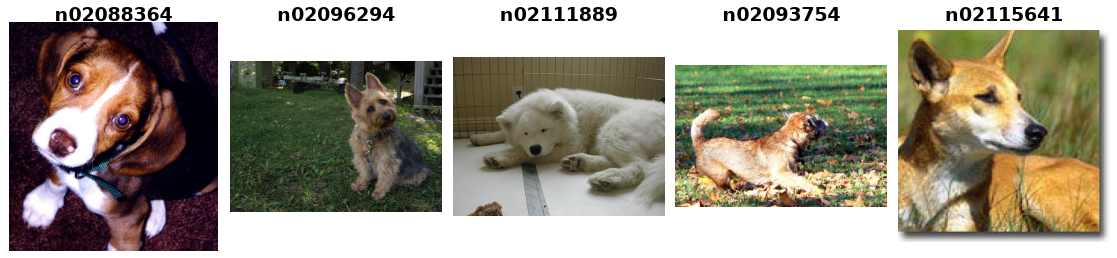
Labels follow this fixed order of ImageNet class identifiers:
0 n02086240    1 n02087394    2 n02088364    3 n02089973    4 n02093754
5 n02096294    6 n02099601    7 n02105641    8 n02111889    9 n02115641
Source and citation
@software{Howard_Imagewoof_2019,
    title={Imagewoof: a subset of 10 classes from Imagenet that aren't so easy to classify},
    author={Jeremy Howard},
    year={2019},
    month={March},
    publisher={GitHub},
    url={https://github.com/fastai/imagenette#imagewoof}
}