UCI Optdigits
Overview
The Optical Recognition of Handwritten Digits (Optdigits) dataset contains 5,620 handwritten digit samples across 10 classes (0-9).
Each sample consists of 64 intensity features representing an 8 x 8 grayscale image.
The builder preserves the original UCI training and test splits:
Train: 3,823 samples.
Test: 1,797 samples.
Classes: 10 digit labels, numbered 0 through 9.
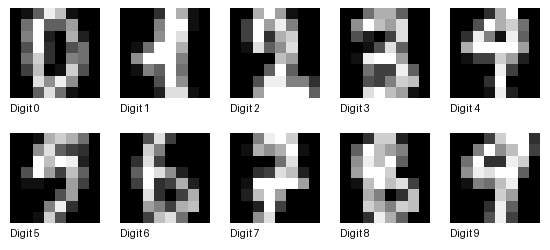
Data Structure
Each example contains the following fields:
Key |
Type |
Description |
|---|---|---|
|
|
8 x 8 grayscale handwritten digit image |
|
int |
Digit label from 0 to 9 |
Usage Example
from stable_datasets.images import Optdigits

train_ds = Optdigits(split="train")
test_ds = Optdigits(split="test")

sample = train_ds[0]

print("Training samples:", len(train_ds))
print("Testing samples:", len(test_ds))
print("Image size:", sample["image"].size)
print("Digit label:", sample["label"])
Dataset Details
Task: Image classification / handwritten digit recognition
Image size: 8 x 8
Image mode: Grayscale
Total samples: 5,620
Number of classes: 10
Original feature count: 64
Original pixel intensity range: 0-16
Output pixel intensity range: 0-255
Splitting: Official UCI train/test files
Downloading: Automatic through the dataset builder
The original 64 features are reshaped into an 8 x 8 array. Pixel intensities are scaled by 255/16, rounded to the nearest integer, and converted to unsigned 8-bit grayscale pixels.
Validation
All 5,620 images and labels were compared with their corresponding entries in the original UCI training and test files.
A 1-nearest-neighbor classifier achieved 97.89% accuracy on the 1,797-sample test split (1,759 correct predictions). This is a basic classification validation experiment, not a benchmark claim.
References
UCI Machine Learning Repository: https://archive.ics.uci.edu/dataset/80/optical+recognition+of+handwritten+digits
Original training file: https://archive.ics.uci.edu/ml/machine-learning-databases/optdigits/optdigits.tra
Original test file: https://archive.ics.uci.edu/ml/machine-learning-databases/optdigits/optdigits.tes
Citation
@misc{uci_optdigits,
    title={Optical Recognition of Handwritten Digits},
    author={Alpaydin, E. and Kaynak, C.},
    year={1998},
    publisher={UCI Machine Learning Repository}
}