Office-Home



Overview
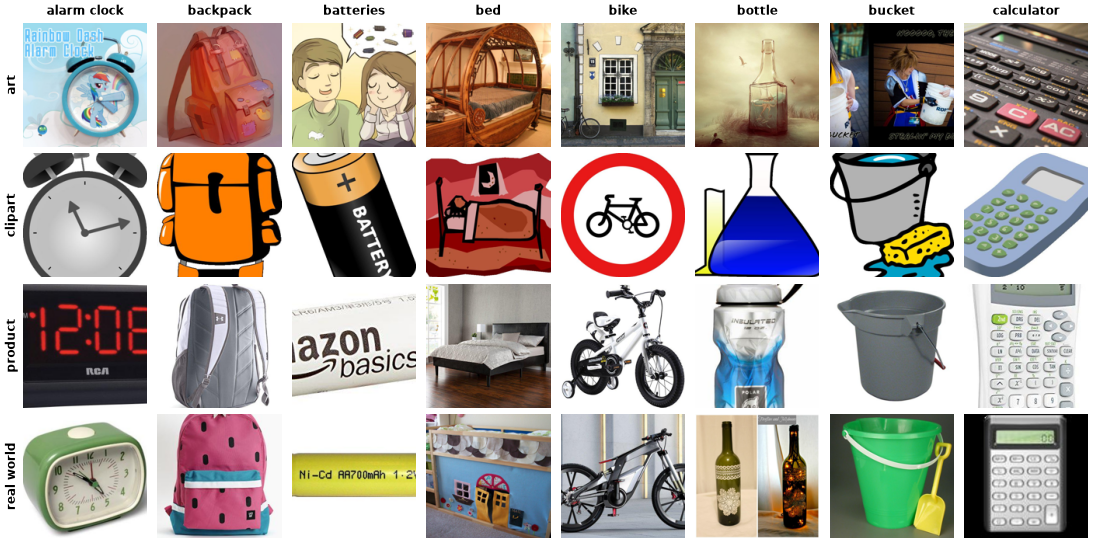
Office-Home is a domain adaptation and domain generalization benchmark with 15,588 images of 65 everyday objects found in offices and homes (alarm clock, backpack, laptop, mug, …). Every class appears in four domains. Compared to PACS it has many more classes and few images per (domain, class) pair, which makes it a harder fine-grained transfer task.
Domain |
Content |
Images |
|---|---|---|
art |
Paintings, sketches and artistic depictions |
2,427 |
clipart |
Clip art images |
4,365 |
product |
Product photos without background |
4,439 |
real_world |
Regular camera photos |
4,357 |
Total |
15,588 |
Dataset Configurations
The original release (OfficeHomeDataset_10072016.zip) has no official train/test split, so the builder offers
two protocols.
random (default)
A stratified 80/20 train/test split inside every (domain, class) pair, so every domain and class appears in both splits. Images are assigned by a SHA-256 hash of their bytes, so the split is reproducible and does not depend on file order. Use this config as an in-distribution benchmark.
art, clipart, product, real_world (leave-one-domain-out)
train holds every image from the other three domains, test holds every image from the named domain.
This is the standard domain generalization protocol: the model never sees the test domain during training.
Data Structure
When accessing an example using ds[i], you will receive a dictionary with the following keys:
Key |
Type |
Description |
|---|---|---|
|
|
Variable resolution RGB image (non-RGB inputs are converted) |
|
int |
Class label (0-64) |
|
int |
Domain index (0: art, 1: clipart, 2: product, 3: real_world) |
Usage Example
Basic Usage (random split)
from stable_datasets.images import OfficeHome

ds_train = OfficeHome(split="train")
ds_test = OfficeHome(split="test")

sample = ds_train[0]
print(sample.keys())  # {"image", "label", "domain"}
print(ds_train.features["label"].names[sample["label"]])

ds_torch = ds_train.with_format("torch")
Leave-One-Domain-Out
from stable_datasets.images import OfficeHome

# Train on art, product and real_world; evaluate on clipart
ds_train = OfficeHome(config_name="clipart", split="train")
ds_test = OfficeHome(config_name="clipart", split="test")
print(len(ds_train), len(ds_test))  # 11223 4365
References
Official website and download: https://www.hemanthdv.org/officeHomeDataset.html
License: fair-use notice, non-commercial research and educational use only (see the official website)
Citation
@inproceedings{venkateswara2017deep,
  title     = {Deep Hashing Network for Unsupervised Domain Adaptation},
  author    = {Venkateswara, Hemanth and Eusebio, Jose and Chakraborty, Shayok and Panchanathan, Sethuraman},
  booktitle = {Proceedings of the IEEE Conference on Computer Vision and Pattern Recognition (CVPR)},
  pages     = {5018--5027},
  year      = {2017}
}