Olivetti Faces
Overview
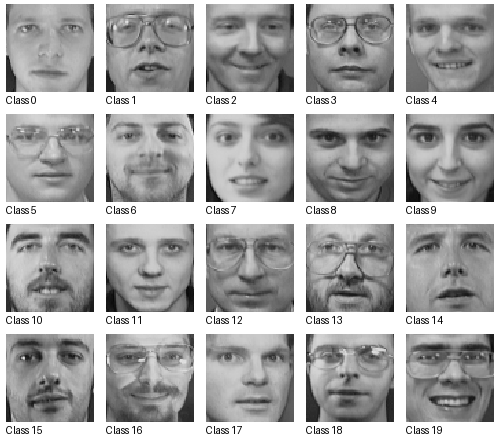
Olivetti Faces is a grayscale face classification dataset containing 400 images from 40 individuals, with 10 images per individual. Each image has a resolution of 64 x 64 pixels.
This builder uses a deterministic split defined by this contribution:
Train: 320 images (8 per individual).
Test: 80 images (2 per individual).
Classes: 40 identity labels, numbered 0 through 39.
The first 8 images of each identity are assigned to training, and the remaining 2 are assigned to testing. This is not an official train/test split provided by the original dataset.
Data Structure
Each example contains the following fields:
Key |
Type |
Description |
|---|---|---|
|
|
64 x 64 grayscale face image |
|
int |
Identity label from 0 to 39 |
Usage Example
from stable_datasets.images import OlivettiFaces

train_ds = OlivettiFaces(split="train")
test_ds = OlivettiFaces(split="test")

sample = train_ds[0]

print("Training images:", len(train_ds))
print("Testing images:", len(test_ds))
print("Image size:", sample["image"].size)
print("Identity label:", sample["label"])
Dataset Details
Task: Image classification / face identification
Image size: 64 x 64
Image mode: Grayscale
Total images: 400
Number of classes: 40
Original format: MATLAB MAT file
Splitting: Deterministic, stratified 8/2 per identity
Downloading: Automatic through the dataset builder
Validation
All 400 images and labels were compared with their original source entries. The training and test source indices were verified to be disjoint.
A 1-nearest-neighbor classifier achieved 88.75% accuracy on the 80-image test split (71 correct predictions). This is a basic classification validation experiment, not a benchmark claim.
References
scikit-learn dataset description: https://scikit-learn.org/stable/datasets/real_world.html#olivetti-faces-dataset
Original data file: https://ndownloader.figshare.com/files/5976027
Citation
@misc{olivettifaces,
    title={The Olivetti Faces Dataset},
    howpublished={AT&T Laboratories Cambridge}
}
License Information
The original dataset is attributed to AT&T Laboratories Cambridge. The source documentation requests attribution when using the images, but does not specify an explicit license for the dataset itself.
The dataset license is therefore recorded as Unknown. This does not imply that the dataset is in the public domain or available for unrestricted redistribution.