Robot Execution Failures
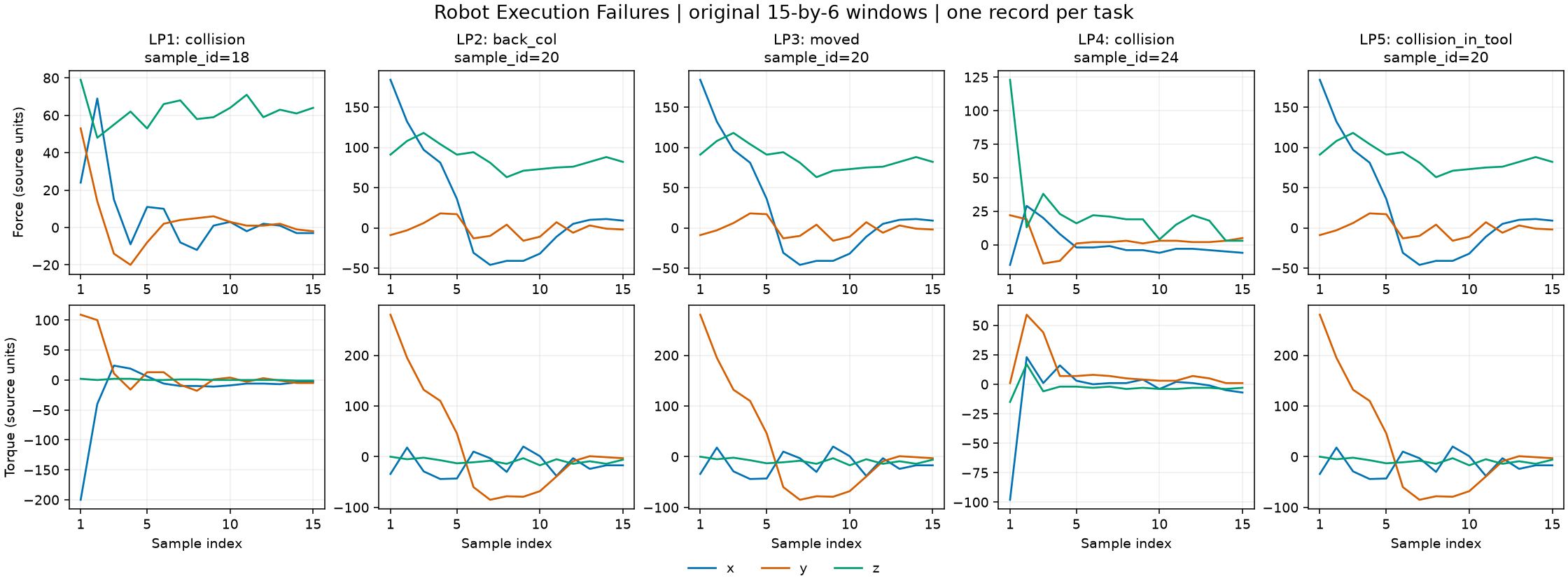
Fig. 7 The first non-normal record from each task, with original sample IDs shown above. Force and torque are plotted separately in source units, without normalization. Panel scales differ; sample index is not time. Repeated curves across tasks reflect shared records in the original source.
Source and structure
Official UCI source lists CC BY 4.0. Citation: Lopes, L. & Camarinha-Matos, L. (1998), Robot Execution Failures, UCI Machine Learning Repository, https://doi.org/10.24432/C5M89N.
Each sample has a time-major float32 series of shape (15, 6),
zero-based label and zero-based sample_id in original file order.
Channels are Fx, Fy, Fz, Tx, Ty, Tz. The source contains integer-valued measurements;
the loader validates that conversion to float32 is lossless. No normalization,
resampling or windowing is added. The observation window is 315 milliseconds;
no sampling-rate assumption is added.
Five configurations retain the source learning problems and their own label spaces:
lp1(default): approach to grasp, 88 records, 4 classes.lp2: transfer of a part, 47 records, 5 classes.lp3: position after transfer failure, 47 records, 4 classes.lp4: approach to ungrasp, 117 records, 3 classes.lp5: motion with part, 164 records, 5 classes.
Each exposes only train. The source has no official train/test split or
session/robot identifiers. Do not pool tasks as interchangeable labels.
Some identical signal windows occur across tasks; they are preserved.
Only the selected text member is read; bundled executables are never run.
Usage
import numpy as np
from stable_datasets.timeseries import RobotExecutionFailures

dataset = RobotExecutionFailures(config_name="lp1", split="train")
signal = np.asarray(dataset[0]["series"], dtype=np.float32)
labels = RobotExecutionFailures.CLASS_NAMES["lp1"]
All configurations share one checksum-verified raw archive, with separate
processed caches. Nested sequences may remain lists under formatting; convert
explicitly with NumPy or torch.as_tensor.
Citation
@misc{robot_execution_failures_138,
  author = {Lopes, Luis and Camarinha-Matos, Luis},
  title = {Robot Execution Failures},
  year = {1998},
  publisher = {UCI Machine Learning Repository},
  doi = {10.24432/C5M89N},
  url = {https://doi.org/10.24432/C5M89N}
}