UCI HAR
Overview
UCIHAR loads smartphone inertial signals from 30 participants performing
six activities. The source provides filtered, overlapping windows of 128 samples
at 50 Hz (2.56 seconds per window). The builder retains the nine signal channels;
it does not load the separate 561-feature vectors or apply further preprocessing.
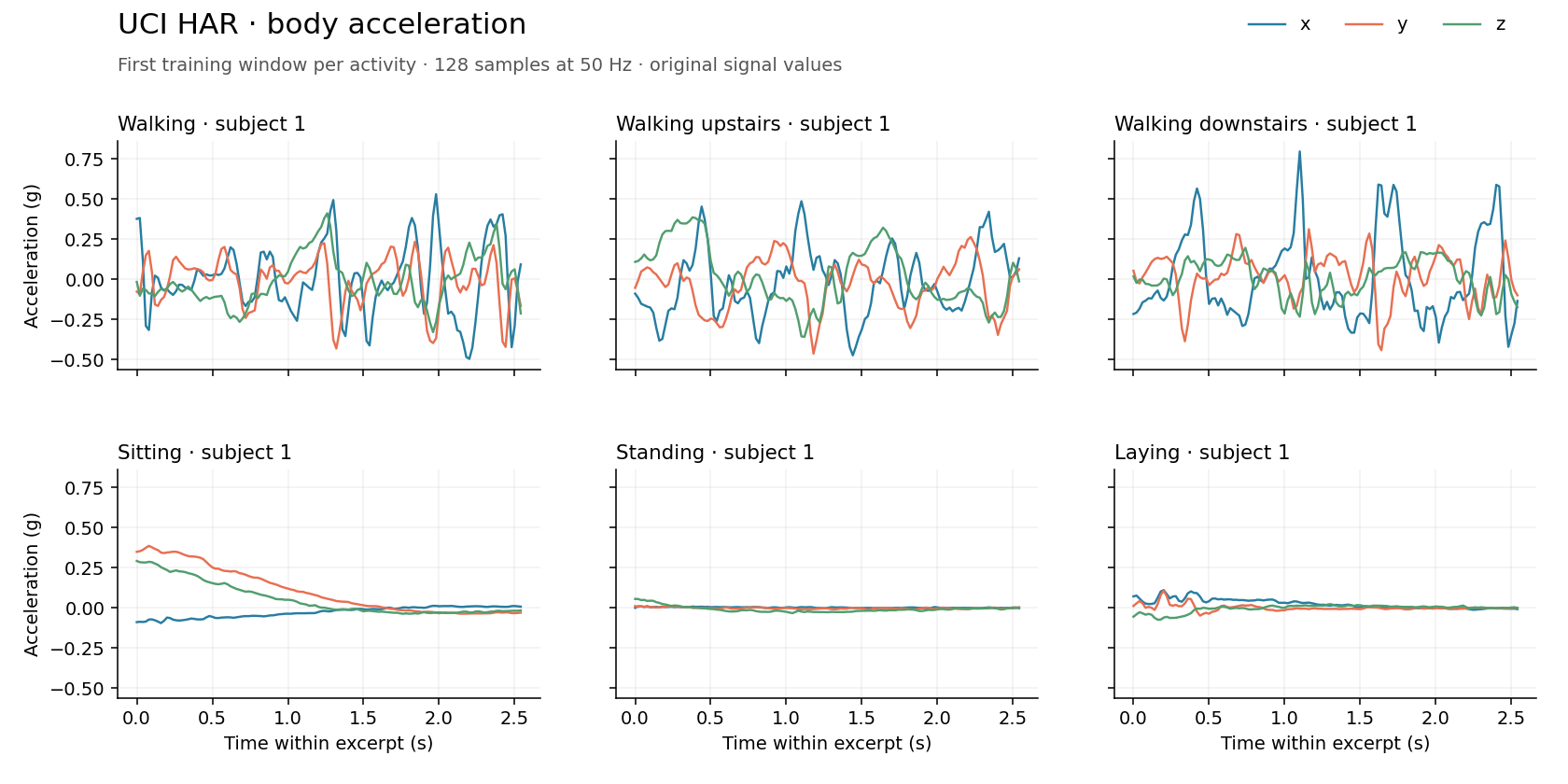
The figure shows the first training window for each activity. Each panel covers one window; the panels are not consecutive segments of a recording.
Splits
The official subject-disjoint partitions are preserved:
train: 7,352 windows from 21 subjects.test: 2,947 windows from nine different subjects.
Data Structure
series: a nested list of float32 values with shape(128, 9).label: an integer from 0 to 5, obtained by subtracting one from the source label.subject_id: the original subject identifier, from 1 to 30.
Channels are body acceleration x/y/z, body angular velocity x/y/z, then total
acceleration x/y/z. Acceleration is measured in g and angular velocity in rad/s.
The order is available as UCIHAR.CHANNEL_NAMES.
Labels 0 through 5 denote walking, walking upstairs, walking downstairs, sitting, standing and laying, respectively. The source windows overlap by 50%; the builder preserves their order within each split.
Usage
import numpy as np
from stable_datasets.timeseries import UCIHAR

train = UCIHAR(split="train")
sample = train[0]
signals = np.asarray(sample["series"], dtype=np.float32)
print(signals.shape, sample["label"], sample["subject_id"])
Pass download_dir and processed_cache_dir to choose the raw-download and
Arrow-cache locations, or set STABLE_DATASETS_CACHE_DIR for both.
Source and License
Homepage: https://archive.ics.uci.edu/dataset/240/human+activity+recognition+using+smartphones
License metadata: CC BY 4.0, as listed on the current UCI dataset page.
The README inside the original archive contains an older prohibition on commercial use. This differs from the current UCI page; the builder records UCI’s published license, while this note preserves the discrepancy.
Citation
@misc{uci_har_2013,
  author = {Reyes-Ortiz, Jorge and Anguita, Davide and Ghio, Alessandro and Oneto, Luca and Parra, Xavier},
  title = {Human Activity Recognition Using Smartphones},
  year = {2013},
  publisher = {UCI Machine Learning Repository},
  doi = {10.24432/C54S4K},
  url = {https://doi.org/10.24432/C54S4K}
}
The original study is Anguita et al., A Public Domain Dataset for Human Activity Recognition Using Smartphones, ESANN 2013.