BeeDataset



Overview
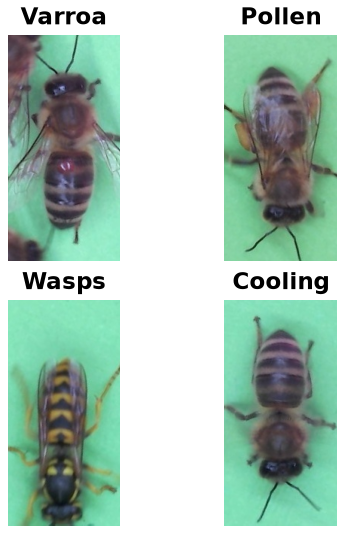
The BeeDataset contains images of bees annotated with four binary labels. Each label represents a separate attribute, allowing an image to have multiple positive labels.
The dataset provides the following labels:
varroa
pollen
wasps
cooling
Train: 7,490 images (the dataset has no official validation or test split)
Data Structure
When accessing an example using ds[i], you will receive a dictionary with the following keys:
Key |
Type |
Description |
|---|---|---|
|
|
Image of a bee. |
|
int |
Binary label indicating the presence or absence of varroa. |
|
int |
Binary label indicating the presence or absence of pollen. |
|
int |
Binary label indicating the presence or absence of wasps. |
|
int |
Binary label indicating the cooling-related annotation. |
Usage Example
Basic Usage
from stable_datasets.images.bee_dataset import BeeDataset

# Load the training split
ds = BeeDataset(split="train")

sample = ds[0]
print(sample.keys())

# Optional: make it PyTorch-friendly
ds_torch = ds.with_format("torch")
References
Dataset website: https://github.com/BeeAlarmed/BeeDataset?tab=readme-ov-file
Tensorflow information source: https://www.tensorflow.org/datasets/catalog/bee_dataset
Original dataset source - deprecated : https://raspbee.de
License: GPL-3.0 LICENSE
Citation
@misc{beealarmed2021,
    title = {Dataset for a camera based bee-hive monitoring},
    author = {Fabian Hickert},
    year = {2021},
    journal = {BeeAlarmed},
    url = {https://github.com/BeeAlarmed}
}