Semeion



Overview
Semeion is a handwritten digit recognition dataset containing 1,593 grayscale images of digits from 0 through 9. It is hosted by the UCI Machine Learning Repository and was contributed by the Semeion Research Center of Sciences of Communication.
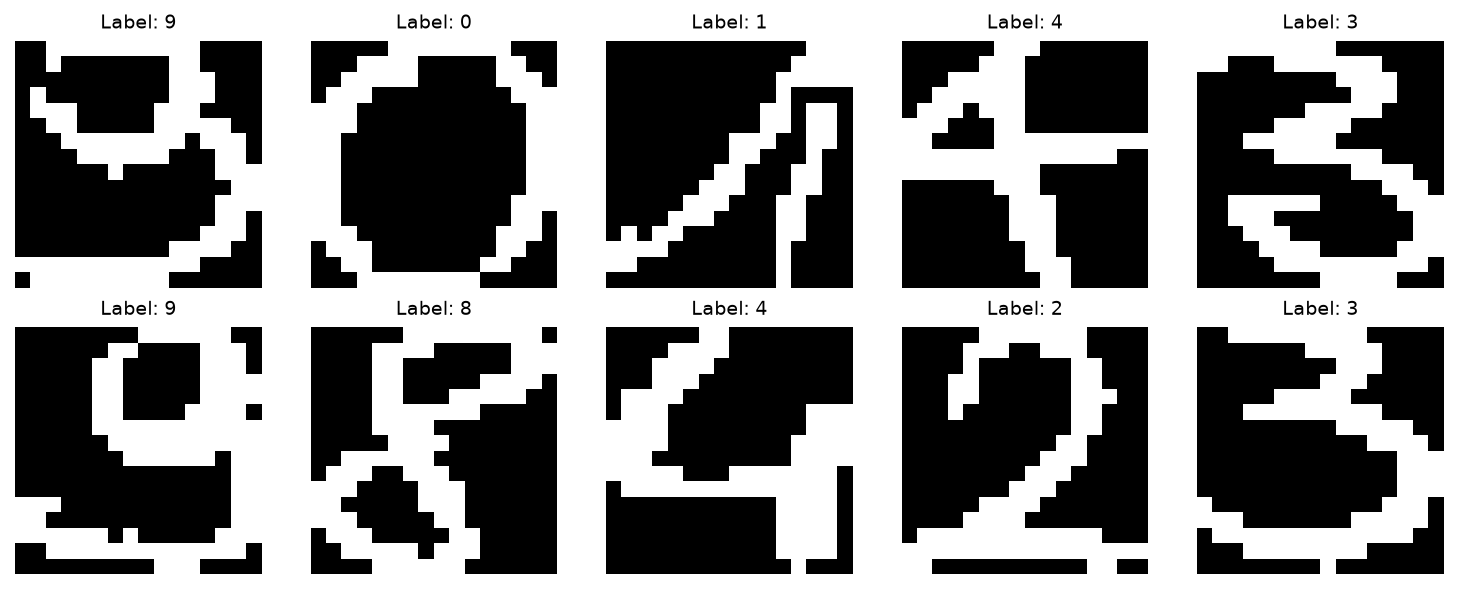
Each image has a resolution of 16x16 pixels, resulting in 256 pixel features per example. The original dataset stores images as flattened vectors of binary pixel values, where each pixel is represented by either 0 or 1.
Each record also contains 10 binary class indicators corresponding to the digits 0 through 9. Exactly one class indicator is active for each example.
The dataset is suitable for supervised image classification, handwritten digit recognition, and evaluating machine learning algorithms on small grayscale images.
Dataset Splits
The original Semeion dataset is distributed as a single data file without predefined training, validation, or test partitions.
This implementation creates a deterministic 80/20 train/test split using a NumPy random generator initialized with seed 42.
The resulting splits are:
Train: 1,274 images
Test: 319 images
Total: 1,593 images
The same permutation is generated for both splits, ensuring that training and test examples are disjoint and that the split remains reproducible across repeated runs.
No separate validation split is provided.
Image Representation
The original dataset contains binary pixel values in flattened vectors of length 256.
During loading, each vector is reshaped into a 16x16 image. Pixel values are multiplied by 255 and converted to unsigned 8-bit integers.
Images are returned as PIL grayscale images using mode L.
The resulting pixel values are:
0: Black255: White
Images retain their original 16x16 resolution. The loader does not apply resizing, normalization, or data augmentation.
The original class indicators are converted into integer labels using the index of the active class.
Labels range from 0 through 9 and correspond directly to the represented handwritten digit.
Data Structure
When accessing an example using ds[i], you receive a dictionary
containing the following fields:
Key |
Type |
Description |
|---|---|---|
|
|
A grayscale handwritten digit image with resolution 16x16. |
|
|
Integer digit class index from 0 to 9. |
Each example contains exactly one image and one class label.
The dataset is configured with supervised_keys=("image", "label"),
allowing it to be used in supervised classification pipelines.
Usage Example
Basic Usage
The following example loads both dataset splits and inspects individual samples.
from stable_datasets.images.semeion import Semeion

def main():
    train = Semeion(split="train")
    test = Semeion(split="test")

    print("Training examples:", len(train))
    print("Test examples:", len(test))

    sample = train[0]

    print("Sample keys:", sample.keys())
    print("Image size:", sample["image"].size)
    print("Image mode:", sample["image"].mode)
    print("Label:", sample["label"])

    # Expected dataset sizes:
    # Training examples: 1274
    # Test examples: 319

    # Expected image properties:
    # Image size: (16, 16)
    # Image mode: L

    class_names = train.features["label"].names
    print("Digit:", class_names[sample["label"]])

if __name__ == "__main__":
    main()
Loading All Splits
Both available splits can be loaded together.
from stable_datasets.images.semeion import Semeion

def main():
    datasets = Semeion(split=None)

    print(datasets.keys())

    train = datasets["train"]
    test = datasets["test"]

    print(len(train))
    print(len(test))

if __name__ == "__main__":
    main()
Inspecting Pixel Values
The following example converts a sample image into a NumPy array to inspect its dimensions and pixel values.
import numpy as np

from stable_datasets.images.semeion import Semeion

def main():
    train = Semeion(split="train")

    sample = train[0]
    pixels = np.asarray(sample["image"])

    print("Shape:", pixels.shape)
    print("Data type:", pixels.dtype)
    print("Unique values:", np.unique(pixels))

    # Shape: (16, 16)
    # Data type: uint8
    # Unique values: [0 255] for images containing both values

if __name__ == "__main__":
    main()
Implementation Details
The loader downloads the original semeion.data file from the
UCI Machine Learning Repository.
Each record contains 266 numerical values:
256 pixel values representing a flattened 16x16 image.
10 binary class indicators representing the digit label.
The implementation validates the expected dataset shape and checks that pixel values and class indicators are binary.
It also verifies that every example has exactly one active class indicator.
After validation, the loader generates a deterministic permutation of example indices and selects the appropriate indices for the requested split.
Each example is returned with an image and an integer label.
References
Citation
@misc{semeion_handwritten_digit_178,
  title        = {{Semeion Handwritten Digit}},
  year         = {1998},
  howpublished = {UCI Machine Learning Repository},
  note         = {{DOI}: https://doi.org/10.24432/C5SC8V}
}