BSDS500



Overview
The Berkeley Segmentation Dataset and Benchmark (BSDS500) is a standard benchmark for unsupervised image segmentation and boundary (contour) detection. It contains 500 natural RGB images of size 481×321 or 321×481. Each image comes with 4 to 9 segmentations drawn independently by different people. There are no class labels: regions are numbered, not named.
Train: 200 images
Validation: 100 images
Test: 200 images
Every human segmentation is given in two forms:
a region map: each pixel holds the number of the region it belongs to (1, 2, 3, …)
a boundary map: 1 on region edges, 0 elsewhere
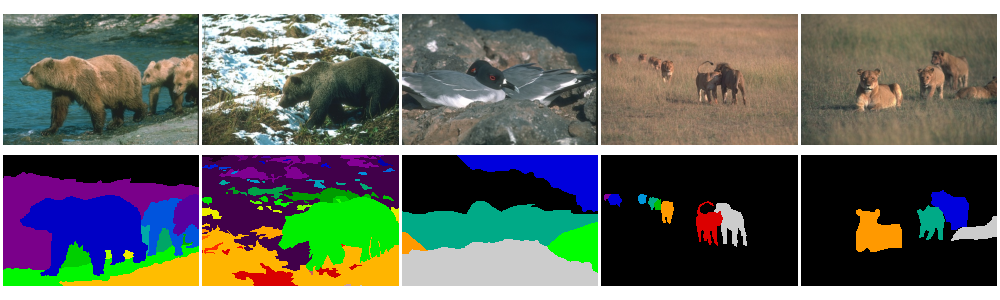
Data Structure
When accessing an example using ds[i], you will receive a dictionary with the following keys:
Key |
Type |
Description |
|---|---|---|
|
|
481×321 or 321×481 RGB image |
|
str |
Original BSDS500 file name without extension (e.g. |
|
list[bytes] |
One PNG-encoded region map per annotator; decode with |
|
list[bytes] |
One PNG-encoded boundary map per annotator; decode with |
The number of annotators varies between images, so segmentations and boundaries are lists of varying length (always equal to each other). decode_mask returns a 2-D uint16 NumPy array with the same height and width as the image.
Usage Example
Basic Usage
from stable_datasets.images import BSDS500
from stable_datasets.images.bsds500 import decode_mask

# First run will download + prepare cache, then return the split
ds = BSDS500(split="train")

# If you omit the split (split=None), you get a dict with all splits:
# "train", "validation", "test"
ds_all = BSDS500(split=None)

sample = ds[0]
print(sample.keys())  # {"image", "image_id", "segmentations", "boundaries"}

# Decode the human annotations into 2-D integer arrays
regions = [decode_mask(b) for b in sample["segmentations"]]
edges = [decode_mask(b) for b in sample["boundaries"]]
print(len(regions), regions[0].shape)  # e.g. 6 (321, 481)
Evaluation
Segmentations are usually evaluated against all human annotations of an image with segmentation covering, the probabilistic Rand index, and variation of information; boundaries with precision/recall and F-measure. The official MATLAB benchmark code is included in the original download (BSR/bench); see Arbeláez et al. (2011) for the protocol.
References
Official website: https://www2.eecs.berkeley.edu/Research/Projects/CS/vision/grouping/resources.html
Original BSDS300 (the first 300 images): https://www2.eecs.berkeley.edu/Research/Projects/CS/vision/bsds/
Citation
@article{arbelaez2011contour,
  title={Contour Detection and Hierarchical Image Segmentation},
  author={Arbel{\'a}ez, Pablo and Maire, Michael and Fowlkes, Charless and Malik, Jitendra},
  journal={IEEE Transactions on Pattern Analysis and Machine Intelligence},
  volume={33},
  number={5},
  pages={898--916},
  year={2011}
}