CIFAR-10N


Overview
CIFAR-10N pairs the 50,000 CIFAR-10 training images with the clean CIFAR-10 labels and five human annotation variants from the CIFAR-N release. It also provides the 10,000 standard CIFAR-10 test images and labels. The test examples have None for the human annotation fields because CIFAR-N annotations cover only training images.
Train: 50,000 images (5,000 per class)
Test: 10,000 images (1,000 per class)
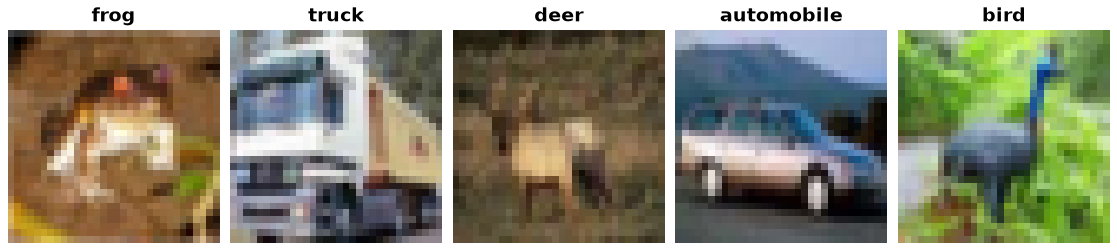
Data Structure
When accessing an example using ds[i], you will receive a dictionary with the following keys:
Key |
Type |
Description |
|---|---|---|
|
|
32x32x3 RGB image |
|
int |
Clean CIFAR-10 class label (0-9) |
|
int or |
Aggregated human annotation (0-9); |
|
int or |
Human annotation selected as the worst label (0-9); |
|
int or |
Human annotation from a randomly selected annotator (0-9); |
|
int or |
Human annotation from a randomly selected annotator (0-9); |
|
int or |
Human annotation from a randomly selected annotator (0-9); |
Usage Example
Basic Usage
from stable_datasets.images.cifar10_n import CIFAR10N

train = CIFAR10N(split="train")
test = CIFAR10N(split="test")
sample = train[0]

print(sample["label"], sample["aggre_label"], sample["worse_label"])
print(sample["random_label1"], sample["random_label2"], sample["random_label3"])
print(test[0]["aggre_label"])  # None: no human annotations are provided for test images
References
CIFAR-N release: https://github.com/UCSC-REAL/cifar-10-100n
License: CC BY-NC 4.0
CIFAR-10 dataset: https://www.cs.toronto.edu/~kriz/cifar.html
Wei et al., Learning with Noisy Labels Revisited: A Study Using Real-World Human Annotations, ICLR 2022: https://openreview.net/forum?id=TBWA6PLJZQm
Citation
@inproceedings{wei2022learning,
  title={Learning with Noisy Labels Revisited: A Study Using Real-World Human Annotations},
  author={Jiaheng Wei and Zhaowei Zhu and Hao Cheng and Tongliang Liu and Gang Niu and Yang Liu},
  booktitle={International Conference on Learning Representations},
  year={2022},
  url={https://openreview.net/forum?id=TBWA6PLJZQm}
}