Caltech Camera Traps (CCT20)



Overview
CCT20 is the camera-trap benchmark introduced in “Recognition in Terra Incognita” (ECCV 2018). It contains 57,864 images from 20 camera locations in the Southwestern United States, taken by motion- and heat-triggered cameras by day and by night (infrared). The images in this builder are the authors’ reduced-size release, 1024 pixels wide.
Its official splits test generalization to new environments: besides the training split, there are validation and test splits at the 10 training locations (“cis”) and at 10 locations never seen in training (“trans”).
Train: 13,546 images (10 locations)
Validation (
cis_val): 2,489 images (training locations)Test (
cis_test): 14,646 images (training locations)trans_validation (
trans_val): 1,603 images (1 unseen location)trans_test: 21,488 images (9 unseen locations)
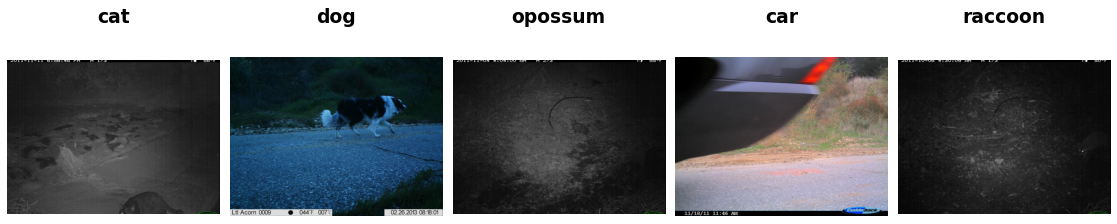
Data Structure
When accessing an example using ds[i], you will receive a dictionary with the following keys:
Key |
Type |
Description |
|---|---|---|
|
|
RGB camera-trap image, 1024×747 or 1024×768 |
|
int |
Class label (0-14) |
|
int |
Camera location id, e.g. to analyze results per location |
Classes
Label |
Class Name |
Training Images |
|---|---|---|
0 |
opossum |
2,726 |
1 |
raccoon |
1,027 |
2 |
squirrel |
1,249 |
3 |
bobcat |
785 |
4 |
skunk |
229 |
5 |
dog |
820 |
6 |
coyote |
1,403 |
7 |
rabbit |
2,443 |
8 |
bird |
484 |
9 |
cat |
1,287 |
10 |
badger |
3 |
11 |
car |
668 |
12 |
deer |
42 |
13 |
fox |
5 |
14 |
rodent |
375 |
The classes are strongly imbalanced (badger and fox have fewer than 10 training images), so report per-class or class-balanced metrics alongside accuracy.
Usage Example
Basic Usage
from stable_datasets.images import CCT20

train_ds = CCT20(split="train")
val_ds = CCT20(split="validation")  # cis_val: locations seen in training
test_ds = CCT20(split="test")  # cis_test: locations seen in training

sample = train_ds[0]
print(sample.keys())  # {"image", "label", "location"}
Generalization to Unseen Locations
from stable_datasets.images import CCT20

seen = CCT20(split="test")  # cis_test
unseen = CCT20(split="trans_test")  # 9 camera locations never seen in training
Getting Class Names
from stable_datasets.images import CCT20

ds = CCT20(split="train")
class_names = ds.info.features["label"].names
print(class_names[ds[0]["label"]])
Notes
Excluded images: images labeled
emptyare excluded. The class has no training images (it occurs only in the validation and test splits), so a classifier trained on this data could never predict it. The 78 images annotated with more than one category are excluded as well, since each example has a single label. Without these exclusions the splits contain 13,553 / 3,484 / 15,827 / 1,725 / 23,275 images.Grayscale images: 551 night-time infrared images are grayscale in the source archive; the builder converts them to RGB so that every image has three channels.
Near-duplicates in the validation split: camera traps take short bursts of photos. 224 such bursts have frames in both
trainandcis_val, so the official validation split contains near-duplicates of training images.cis_testand thetranssplits have no such overlap.Hosting: the archives (6.5 GB of images, 3 MB of annotations) are downloaded from LILA’s Google Cloud Storage bucket, with LILA’s Azure mirror as fallback, and verified with MD5 checksums.
References
Homepage: https://lila.science/datasets/caltech-camera-traps
Benchmark page: https://beerys.github.io/CaltechCameraTraps/
License: Community Data License Agreement – Permissive, Version 1.0 (CDLA-Permissive-1.0)
Citation
@inproceedings{beery2018recognition,
  title = {Recognition in Terra Incognita},
  author = {Beery, Sara and Van Horn, Grant and Perona, Pietro},
  booktitle = {Proceedings of the European Conference on Computer Vision (ECCV)},
  year = {2018}
}