Shapes3D


Overview
The Shapes3D dataset (also known as 3dshapes) is a synthetic benchmark designed for disentangled and unsupervised representation learning. It was introduced in the FactorVAE paper by Kim & Mnih (ICML 2018) as a standard testbed for learning interpretable latent representations.
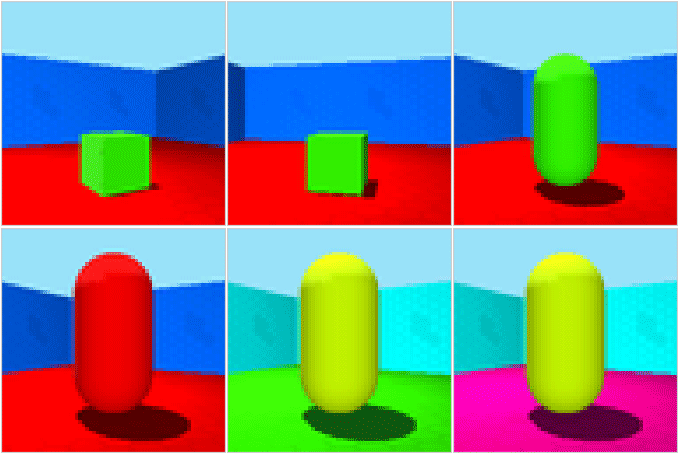
The dataset consists of procedurally generated images of 3D scenes, where a single object is rendered in a simple environment with six independent, ground-truth factors of variation that are explicitly controlled.
Unlike real-world datasets, Shapes3D is generated as a complete Cartesian product over all factors. Every possible combination of factor values appears exactly once, making the dataset well suited for systematic and controlled disentanglement evaluation.
Total images: 480,000
Image resolution: 64×64×3 (RGB)
Latent Factors of Variation
Each image is generated from six independent factors:
Factor |
Values |
Cardinality |
|---|---|---|
|
Linearly spaced in [0, 1] |
10 |
|
Linearly spaced in [0, 1] |
10 |
|
Linearly spaced in [0, 1] |
10 |
|
Linearly spaced in [0.75, 1.25] |
8 |
|
{0, 1, 2, 3} |
4 |
|
Linearly spaced in [-30, 30] |
15 |
Each image corresponds to a unique combination of these six factors.
The images are stored in row-major order, where the fastest-changing factor is
orientation and the slowest-changing factor is floor_color.
Data Structure
When accessing an example using ds[i], you will receive a dictionary with the following keys:
Key |
Type |
Description |
|---|---|---|
|
|
64×64 RGB image |
|
|
Continuous factor values:
|
|
|
Discrete factor indices corresponding to |
|
|
Individual continuous factor values |
|
|
Individual discrete factor indices |
Usage Example
Basic Usage
from stable_datasets.images.shapes3d import Shapes3D

ds = Shapes3D(split="train")

sample = ds[0]

image = sample["image"]
label = sample["label"]
label_index = sample["label_index"]

floor, wall, obj, scale, shape, orientation = label
floor_idx, wall_idx, obj_idx, scale_idx, shape_idx, orientation_idx = label_index

image.show()

# Optional: make it PyTorch-friendly
ds_torch = ds.with_format("torch")
Why No Train/Test Split?
Shapes3D does not define an official train/test split. The dataset is intended for representation learning, where the objective is to discover and disentangle latent generative factors rather than to generalize across semantic classes.
Because Shapes3D is a complete Cartesian product of all factor combinations, most evaluation protocols rely on:
Factor-wise interventions
Disentanglement metrics
Controlled generalization across factors
References
Dataset homepage: https://github.com/google-deepmind/3dshapes-dataset
License: Apache License 2.0
Paper: Kim & Mnih, Disentangling by Factorising, ICML 2018
Citation
@InProceedings{pmlr-v80-kim18b,
  title = {Disentangling by Factorising},
  author = {Kim, Hyunjik and Mnih, Andriy},
  booktitle = {Proceedings of the 35th International Conference on Machine Learning},
  pages = {2649--2658},
  year = {2018},
  editor = {Dy, Jennifer and Krause, Andreas},
  volume = {80},
  series = {Proceedings of Machine Learning Research},
  month = {10--15 Jul},
  publisher = {PMLR}
}